How to find a “walk through walls” employee for 70% less than a local hire (without the Fiverr gamble)
A Walk Through Walls Employee is a high-accountability professional characterized by extreme ownership and a relentless drive to solve problems without constant supervision. Unlike task-based freelancers, these “rockstars” act as internal partners who proactively overcome obstacles to achieve a business’s core operational objectives.
I just overheard a conversation at a party that should terrify every small business owner in America.
A 22-year-old with zero skills and no experience was explaining why she refused to work for less than $80,000 a year. She was not joking. She truly felt the world owed her a high salary just for showing up.
This is the “Entitlement Gap.” It is the reason you feel like you are setting money on fire every time you post a job ad.
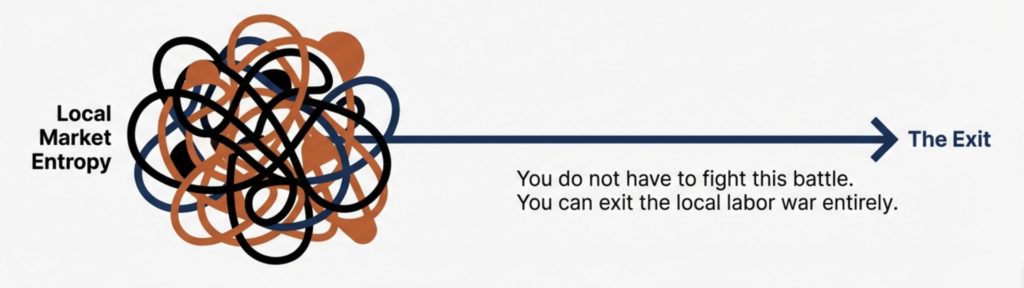
If you feel like hiring is a nightmare right now, it is not your fault. You are fighting an external enemy: Marketplace Entropy. Inflation, high cost of living, and weird societal shifts have created a local labor market that is completely detached from reality.
The good news is that you do not have to fight this battle. You can exit the local labor war entirely.
The Solar Salesman Effect

Most business owners avoid hiring globally because of what I call the Solar Salesman Effect.
Imagine a guy knocks on your door to talk about your roof. You do not know anything about roofs. You feel a flash of fear because you do not want to be scammed, so you just shut the door.
We do the same thing with hiring in places like the Philippines, Colombia, or South Africa. We fear the unknown. We worry about internet speeds, security, or “third world” problems.
But once you realize these professionals use the same high-speed internet, went to similar colleges, and use the same computers as we do, that fear disappears. In fact, many global professionals have more dedication and better work ethics than someone you could hire in your own zip code.
The only thing standing between you and a rockstar team is knowing where to look and how to manage them.
The Flea Market Trap: Why Upwork and Fiverr Fail You
When founders finally decide to look outside their zip code, they usually head straight to Upwork or Fiverr. This is where the gamble begins.
These sites are marketplaces, not partners. Think of them like a digital flea market. You can find some great deals, but you are also dealing with a lot of chaos.
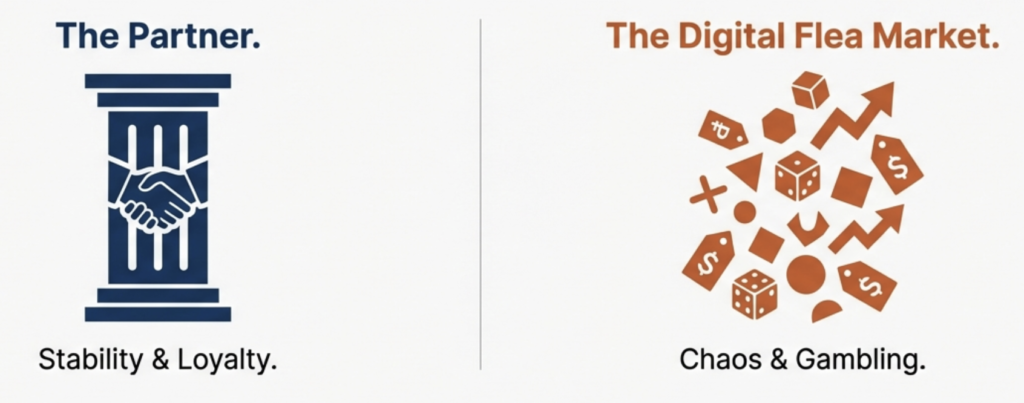
There are three big reasons these platforms create “Marketplace Entropy” in your business:
1. Zero Brand Loyalty On a marketplace, the freelancer belongs to the platform, not to you. They can disappear tomorrow with your passwords, your data, and your IP. You have no recourse.
2. The Hidden “Shadow Tax” Platforms often take 20% to 25% of the worker’s pay. If you pay $1,000, the worker might only see $750. This leads to resentment and low-quality work. They are always looking for a better gig that pays them what they are actually worth.
3. The Rise of the Ghost Candidate In 2026, almost half of all resumes are made by AI. On Upwork, people look perfect on paper but cannot think critically in real life. If you do not have a master-level vetting process, you will end up hiring a “bot” in a human suit.
The Hierarchy of Global Hiring
To find that “walk through walls” employee, you have to understand the three main ways to hire. Each has pros and cons.
1. The Marketplace (Fiverr/Upwork)
This is for the “one-night stand” of business. Use this if you need a logo designed or a one-time list of emails scraped. Get in, get the work, and get out. Do not try to build a long-term culture here. It is too risky for your core operations.
2. The Finder’s Fee Agency
These agencies find talent and hand them over to you for a flat fee. This is a great, economical choice if you already run a “tight ship.”
However, you should only do this if you have:
- Written SOPs for every task.
- Daily huddles already in place.
- A clear way to track results every day.
If you do not have those things, the VA will wait around for instructions you aren’t ready to give. They will fail within 30 days, and you will have wasted your placement fee.
3. Managed Talent
This is the “Rockstar” option. In this model, an agency helps you find the person, but they also manage the human for you every single day.
This is the ideal choice for most entrepreneurs who are busy scaling. You get the benefit of a global salary (saving 70% vs. local), but you do not have the headache of being a full-time remote manager.
How to Spot Real Management
Many companies claim they “manage” the talent for you. Most of the time, they are lying. They are doing “Loss Prevention,” which means they do the bare minimum to keep you paying the monthly bill.
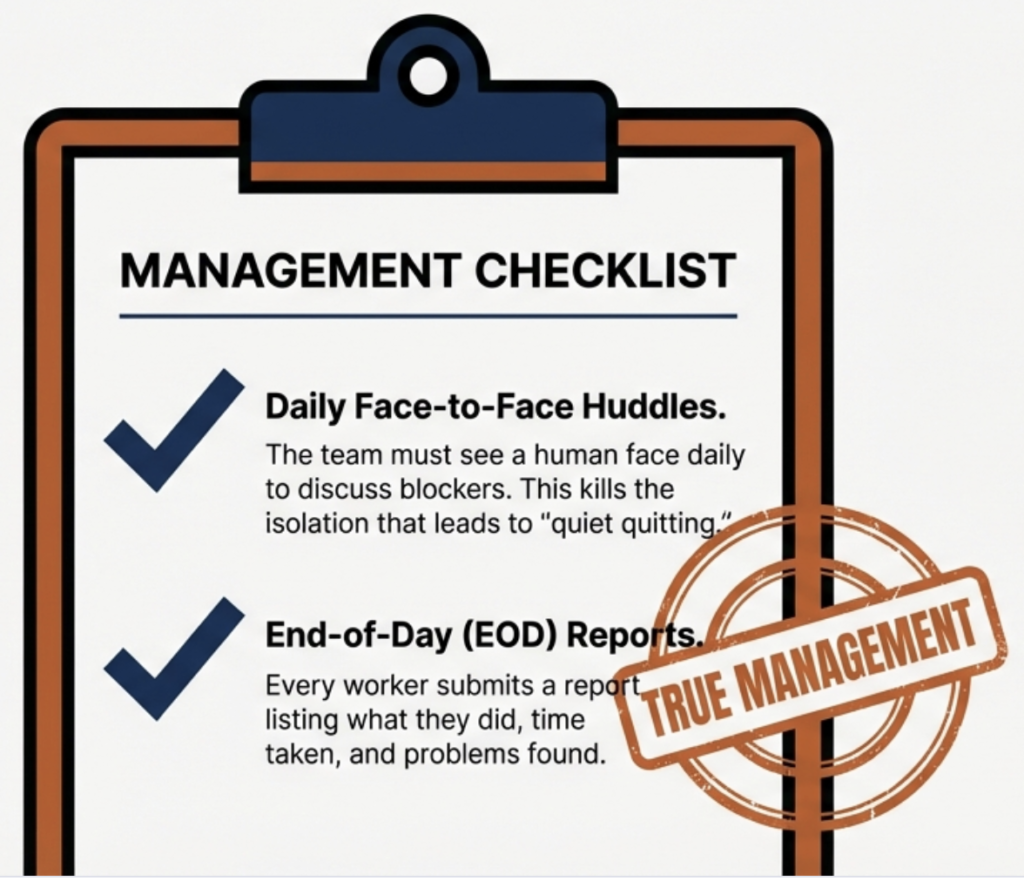
True management requires two non-negotiables:
Daily Face-to-Face Huddles Your team needs to see a human face every day. They need to talk about what they are doing and where they are stuck. This kills the isolation that leads to “quiet quitting.”
End-of-Day (EOD) Reports Every worker must submit a report at the end of their shift. It should list what they did, how long it took, and any problems they found. This creates a loop of accountability that makes failure almost impossible.
The Bottom Line on Global Hiring
You can hire a “cheap” VA for $1,000 a month on Upwork and set that money on fire because they produce nothing. Or, you can spend $2,000 a month on managed talent and get an employee who produces like a $100,000-a-year executive.
The extra cost is not an expense… it is an insurance policy for your sanity.
If you are tired of the local “Entitlement Gap,” stop trying to find better people in a broken market. Instead, build a system that allows global rockstars to do their best work for you.
Have you ever tried hiring a VA and had them disappear on you, or are you still trying to make local hiring work?