Why I Stopped Hiring in the Philippines
I want to be very clear before we start. This is not an attack on the Philippines. I have had Filipino team members for years. They are some of the kindest and most hardworking people on the planet.
But as a business owner, I have learned that being a “good person” and being a “good fit” for a fast-paced business are two different things.
If you have ever felt like your remote team was ghosting you, or if they just nodded their head while a project crashed, please do not blame yourself. You are not a bad boss. You likely just fell into a trap created by an “External Enemy” you didn’t even know existed: a mismatch in culture and biology.
I stopped hiring in the Philippines because I realized I was fighting an uphill battle against three cultural traits and one massive biological hurdle.
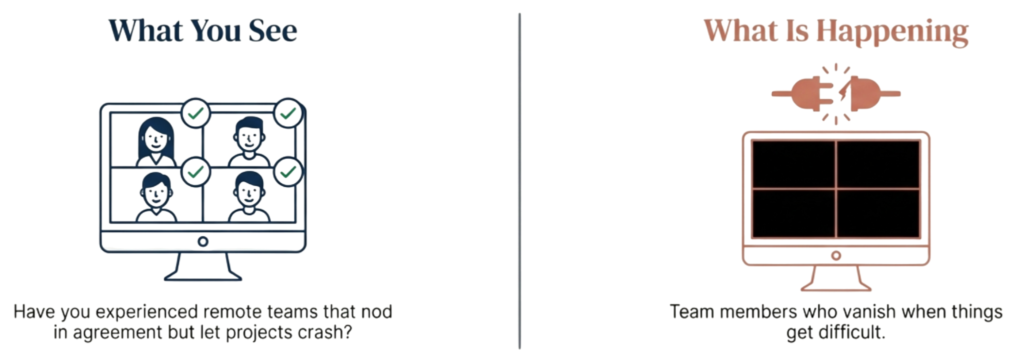
The Three Cultural Roadblocks
In the Philippines, there are three cultural norms that are beautiful in a family setting but can be a nightmare for a scaling business.
The first is called Hiya.
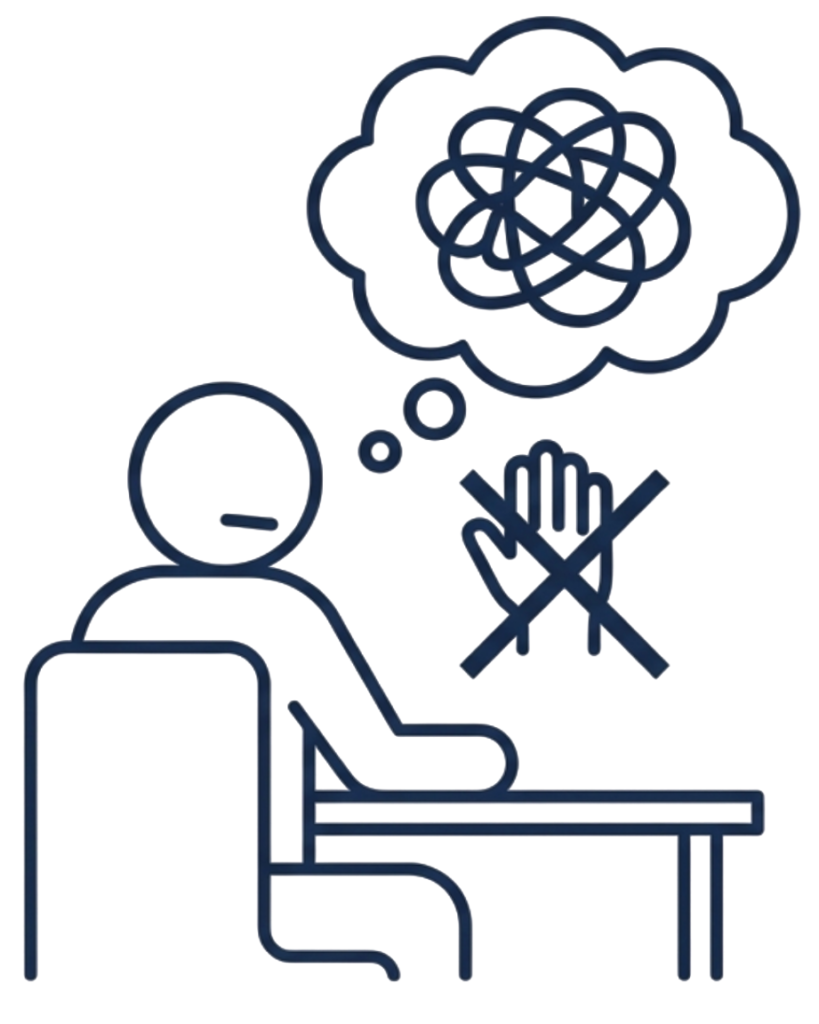
This translates to shame or shyness. It is a deep cultural drive to avoid losing face or causing embarrassment. In a business, you need people to ask questions when they are confused. But if someone feels Hiya, they will stay silent rather than admit they do not understand. They would rather fail quietly than look “dumb” by asking for help.
The second is Pakikisama.
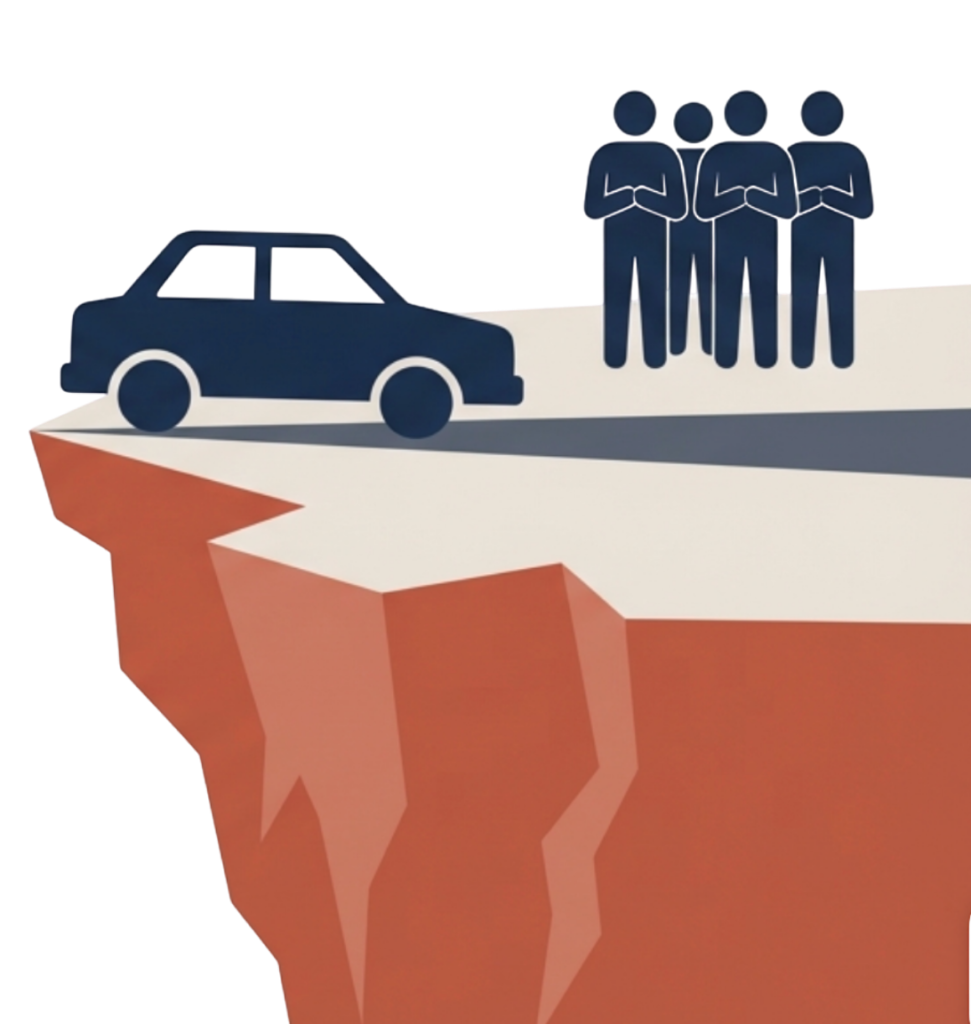
This is the value of group harmony. It sounds great, right? Everyone getting along. But in reality, it often leads to people-pleasing. Your team might see a mistake you made, but they will not tell you because they do not want to “break the harmony.” You need a team that catches your errors, not one that politely watches you drive off a cliff.
The third is Maitisim.

This refers to the trait of enduring hardships without complaint. Again, this sounds like a strength. But if a process in your business is broken or unfair, you need to know immediately. You do not want a team that meekly suffers through a bad system for six months while your profits bleed out.
When you combine these three things, you get a “silent” team. They are lovely people, but they lack the curious mind and the willingness to be challenged that a high-growth company needs.
You Cannot Fight Biology
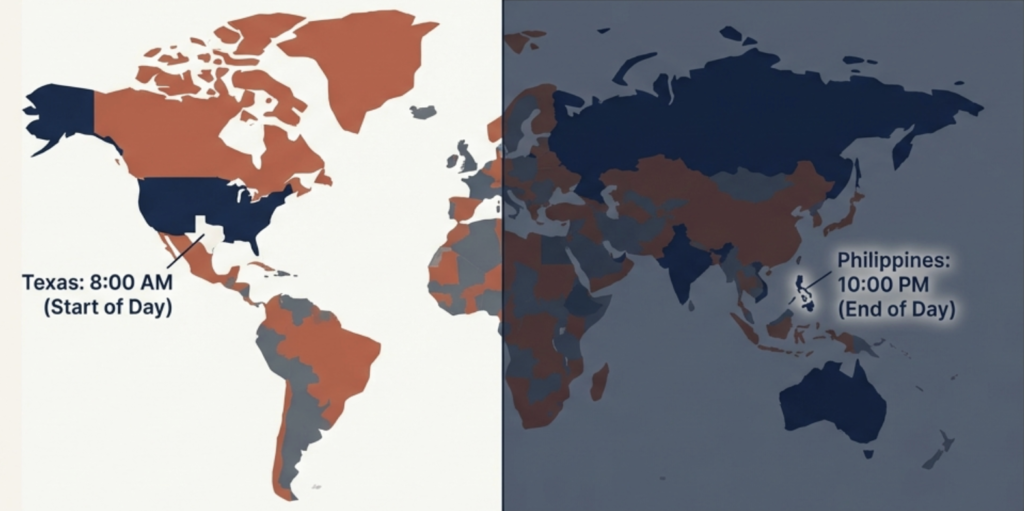
Even if you find the 1% of talent that moves past those cultural norms, you are still fighting an enemy that never sleeps: Circadian Rhythms.
I live in Texas. During the winter, the Philippines is 14 hours ahead of me. When I am starting my day at 8:00 AM, it is already 10:00 PM over there.
Sure, many workers are willing to flip their schedules and work the “graveyard shift.” But you are fighting millions of years of human evolution. People do not thrive when they work while the rest of their world is asleep.
When you have your most sensitive and important work in the hands of someone who is “asleep at the wheel” or exhausted from a flipped schedule, you are taking a massive gamble. You are getting what is left of their energy, not their best.
The Problem With the Four Dollar Wage
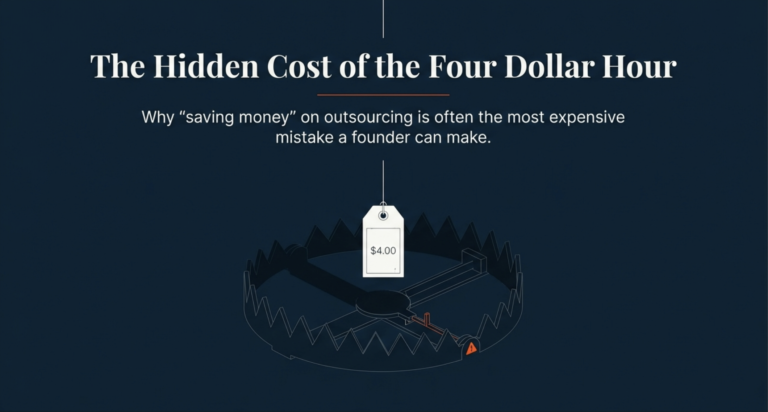
The big draw for hiring in the Philippines is the cost. Agencies love to brag about hiring talent for $3 or $4 an hour.
But I have learned that $4 an hour set on fire is still a waste of money.
To get those rates, you usually have to hire from the “provincial economy.” These are people living in rural areas far from major cities. They might have never traveled outside their village. They do not understand Western business culture, and their Wi-Fi is often spotty at best.What you save in salary, you will pay for in costly errors, constant retraining, and your own gray hair. This is what I call the DIY Tax. It’s the money you lose every hour you spend “fixing” things that should have been done right the first time.
The Nearshore Solution and Social Currency
So, what is the answer? For me, it was moving my focus to Latin America. This created a High-Performance Environment (the “E” in my P.U.L.S.E. framework) almost instantly.
First, the time zones actually line up. When I start work at 8:00 AM, they start at 8:00 AM. Their physiology is on my side. They are in “first shift” mode, which is when humans are most productive.
Second, the cultural proximity is much higher. People in Mexico, Colombia, or El Salvador understand our world because they are already part of it. Most importantly, they have thick skin. They are not afraid to speak up, point out a flaw, or take personal accountability.
But here is the real secret I learned: You do not have to pay the highest dollar to get the best talent. You just have to pay in Social Currency.
Social currency is about how you make a person feel. Most remote workers are used to being treated like “units of production.” When I hire for character—people who are proactive, responsible, and organized—and I treat them with respect and a path to grow, they will walk through walls for me.
My current Operations Manager started as a simple chat support agent. She had no management experience. But she was smart and driven. Today, she runs my entire operation.
Stop Paying the DIY Tax
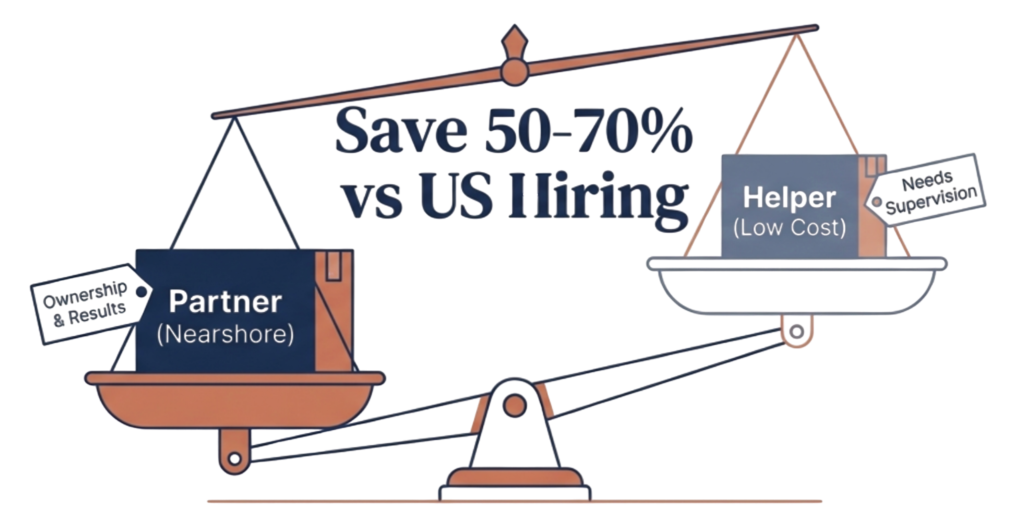
You can still save 50% to 70% compared to hiring locally in the U.S., but you get a partner instead of just a “helper.”
Stop looking for the lowest bidder on the other side of the world and start looking for the best alignment right in your own backyard.
If you want to see exactly how much your current “cheap” labor or DIY habits are costing you, I built a simple calculator to help you run the “Freedom Math.”
Run your numbers here and see your DIY Tax
And if you want to see the specific interview questions I use to test for “thick skin” and the ability to speak up before I hire anyone, drop me a message. I’m happy to share.